Jacek Karpiński Verified
April 9, 1927 , Poland
🇵🇱 Jacek Karpiński (1927–2010)
Some call him the Polish Bill Gates, others the Polish Steve Jobs. Jacek Karpiński was a brilliant engineer, one of the first computer pioneers in Poland, and a man full of innovative ideas.
He was born in 1927 in Turin, Italy, but spent most of his life in Poland. After World War II, he quickly finished his education and started technical studies , first in Łódź, then at the Warsaw University of Technology. From a young age, Karpiński showed amazing talent and technical imagination.
In 1957, he built AAH, a machine for long-term weather forecasting using harmonic analysis. Just two years later, he created AKAT-1, the first transistor-based differential equations analyzer in the world. This invention won first prize in an international competition for young engineers. As a result, Karpiński received scholarships to study at MIT and Harvard in the United States.
While studying in the U.S., he received many job offers. But Karpiński decided to return to Poland. He said, “I came from Poland, so I will return to Poland.”
Back home, he joined the Artificial Intelligence Laboratory at the Polish Academy of Sciences. There, he built a perceptron, a learning machine that used a camera to recognize its surroundings. It was only the second machine of its kind in the world at that time.
He also designed KAR-65, a computer used for analyzing photos of particle collisions. It was twice as fast as the best Polish computers of the time and 30 times cheaper, a major breakthrough.
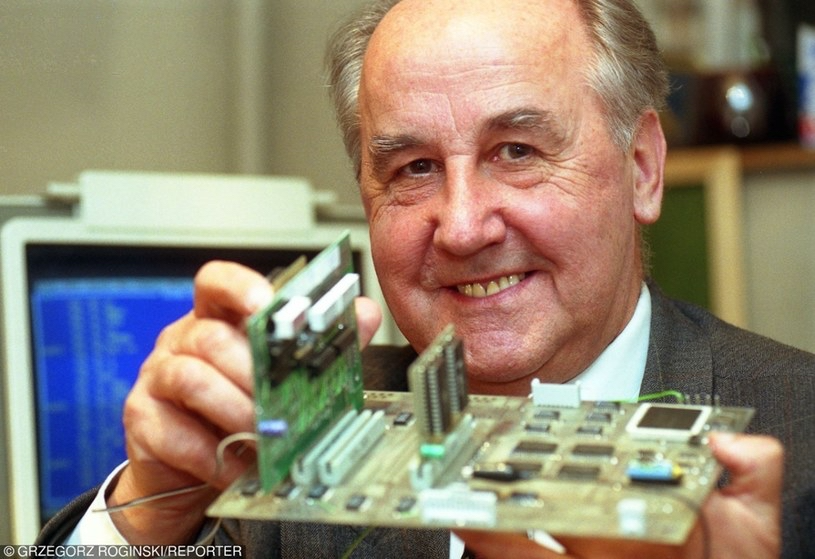
His most important invention could have been the K-202, the first Polish minicomputer. It had 144 kB of memory and could perform one million operations per second, amazing performance in the early 1970s.
🧠 Compact, powerful, and forward-looking, the K-202 had:
• virtual memory
• paged addressing up to 8MB
• asynchronous operation
• and it fit inside a briefcase.
But instead of receiving global investment or scaling production, Karpiński’s work was systematically suppressed.
The Communist Party favored state-controlled projects — and K-202 was too advanced, too independent, too risky.
Sadly, the Polish government did not approve mass production. The reason? K-202 was not compatible with the Soviet computing system called RIAD.
Still, with the help of British investors, Karpiński started a small production line. Only 30 units were built before the project was stopped due to political and economic conflicts.
Later, he moved to Switzerland, where he designed a voice-controlled robot and an “intelligent pen”. Ideas far ahead of their time. In the 1990s, he returned to Poland and worked as a technology advisor.
Jacek Karpiński’s story is both inspiring and tragic. He had the talent and vision to change the world of technology. But political barriers and lack of support blocked his path. Even so, he remains one of the most creative and forward-thinking innovators in Polish history, a man who was truly ahead of his time.
Today, Karpiński is recognized as a visionary — a man who saw what computers could become before Europe was ready to believe it.
Let’s talk about Jacek Karpiński.
#EuropeInnovators #JacekKarpinski #PolishTech #K202 #LostGenius #CTOinBraces #EarlyAI #SovereignComputing #InnovationBlocked
Some call him the Polish Bill Gates, others the Polish Steve Jobs. Jacek Karpiński was a brilliant engineer, one of the first computer pioneers in Poland, and a man full of innovative ideas.
He was born in 1927 in Turin, Italy, but spent most of his life in Poland. After World War II, he quickly finished his education and started technical studies , first in Łódź, then at the Warsaw University of Technology. From a young age, Karpiński showed amazing talent and technical imagination.
In 1957, he built AAH, a machine for long-term weather forecasting using harmonic analysis. Just two years later, he created AKAT-1, the first transistor-based differential equations analyzer in the world. This invention won first prize in an international competition for young engineers. As a result, Karpiński received scholarships to study at MIT and Harvard in the United States.
While studying in the U.S., he received many job offers. But Karpiński decided to return to Poland. He said, “I came from Poland, so I will return to Poland.”
Back home, he joined the Artificial Intelligence Laboratory at the Polish Academy of Sciences. There, he built a perceptron, a learning machine that used a camera to recognize its surroundings. It was only the second machine of its kind in the world at that time.
He also designed KAR-65, a computer used for analyzing photos of particle collisions. It was twice as fast as the best Polish computers of the time and 30 times cheaper, a major breakthrough.
His most important invention could have been the K-202, the first Polish minicomputer. It had 144 kB of memory and could perform one million operations per second, amazing performance in the early 1970s.
🧠 Compact, powerful, and forward-looking, the K-202 had:
• virtual memory
• paged addressing up to 8MB
• asynchronous operation
• and it fit inside a briefcase.
But instead of receiving global investment or scaling production, Karpiński’s work was systematically suppressed.
The Communist Party favored state-controlled projects — and K-202 was too advanced, too independent, too risky.
Sadly, the Polish government did not approve mass production. The reason? K-202 was not compatible with the Soviet computing system called RIAD.
Still, with the help of British investors, Karpiński started a small production line. Only 30 units were built before the project was stopped due to political and economic conflicts.
Later, he moved to Switzerland, where he designed a voice-controlled robot and an “intelligent pen”. Ideas far ahead of their time. In the 1990s, he returned to Poland and worked as a technology advisor.
Jacek Karpiński’s story is both inspiring and tragic. He had the talent and vision to change the world of technology. But political barriers and lack of support blocked his path. Even so, he remains one of the most creative and forward-thinking innovators in Polish history, a man who was truly ahead of his time.
Today, Karpiński is recognized as a visionary — a man who saw what computers could become before Europe was ready to believe it.
Let’s talk about Jacek Karpiński.
#EuropeInnovators #JacekKarpinski #PolishTech #K202 #LostGenius #CTOinBraces #EarlyAI #SovereignComputing #InnovationBlocked